Loan Management System
NBFC Loan Management Software
services
Web Development
industry
FinTech / Lending
duration
1.5 Years
country
Botswana

Project Overview
A custom web-based NBFC Loan Management Solution for a Loan company which automates the end-to-end Loan Management Functionality. Loan Origination System: The system has capabilities to let admin create the institution and its branches. All the data per institution is feed into the system. Setups, Individual and Business Customers, Quick Loan Calculator and Income & Expense Loan Calculator, Individual and Business Loan Application. Loan Management System: The system can onboard the customer for secured as well as unsecured products. There are various types of parameters based on which admin can setup the products in the system and then the loans will be given to customers based on that. Interest Rate Methodologies, Amortization Schedule, Loan Application, Vetting and Disbursement, Reschedule Loan, Auto Generated Loan Documents. Accounting Management System: Once the loan is active it passes through different statuses and each loan is treated in a different way as per its repayment behaviours. Capture Loan Transactions, Settlement Quotation, Debt Collection, Communication. Reports, Calendars and Dashboards: Custom preset reports and dashboard sections are available such that users can use different filters to visualise the statistics and details. Calendar features help people to stay updated with events and add events as and when required. Reports, Dashboards, Calendars, Timely Email and SMS notifications.


Challenges
PWA and Service Worker
Auditing
Offline Drafts
Layout Design
Our Solution
User Interface and Experience
Admin Control and Access Management
Offline Capability and Data Security
Reporting and Automation
Features Implemented
The Loan Management System includes a comprehensive set of features covering product setup, loan origination, disbursement, debt collection, and reporting.
1. Product Setup
All the new products can be added from here with all the details like whether the product is secured or not. One can also define the collaterals associated with each product. The most important functionalities that stand out the system is the ability to add the product per Employer which gives the ability to do deduction at the source for the employees and also give a different interest rate for the employers. There is a various range of repayment options for products like weekly, monthly, quarterly, semi-annually, and annually that gives a wide range of products to be generated and used in the system. The most useful functionality was made dynamic for the user's ease which is the ability to set the repayment order for Installment, Fee & Interest. Also, the user can set the installment repayment to be captured vertically or horizontally for the repayment order per product.

2. Affordability Rules and Loan Calculator
Every loan system has a certain set of affordability rules in a way that customers can be eligible for the products defined in the system. These rules define certain eligibility rules for the customers seeking loans. There are 2 types of calculators available in the system namely quick calculator and quick calculator on Income and Expense which helps the users of the system to Very high level or a detailed quote on the loan products a customer can be eligible for. Based on all the rules the system will calculate what can be the maximum installment a customer can afford and based on that the products will be shown. Not only this there are a number of filters which can give the set of exact match products to the customer.

3. Loan Application, Vetting and Disbursement
The most important 3 stages in which the loan application is created and then disbursed to the customer. A loan application with the detailed 4 step form is being filled in the loan application stage and then it will be sent out to the high authorities for the approval. From the loan vetting process the loan application can be either sent further for the approval for disbursement or it will be rejected back to the loan application stage if it needs to be updated. All the system generated documents will also be generated and the user can download all the documents as per the need and send it to the customer then. They can also upload all the documents that are signed by the customer for the records in the system. The most important and unique feature is that the history of all the edits can be seen in the system. The Loan application can also be filled while the internet connection is not there and synchronised to the server once the internet connection is established.

4. Reschedule
Every loan once active can have multiple actions to be performed on i.e Not all the customers pay the loan as per the pay plan so in such a scenario the loan company approaches the customer via different ways and gives customer flexibility to reschedule the loan as per the affordability. Reschedules are done 3 ways in the system 1. Reschedule a loan by interest 2. Reschedule a loan by Loan Tenure 3. Reschedule a loan by Installment amount. With these options it gives complete flexibility and based on each parameters system computes the rest of the calculations and reschedules a loan. Also, the system gives an ease to users to reschedule multiple loan accounts at once i.e ability to process the bulk reschedule on loan.

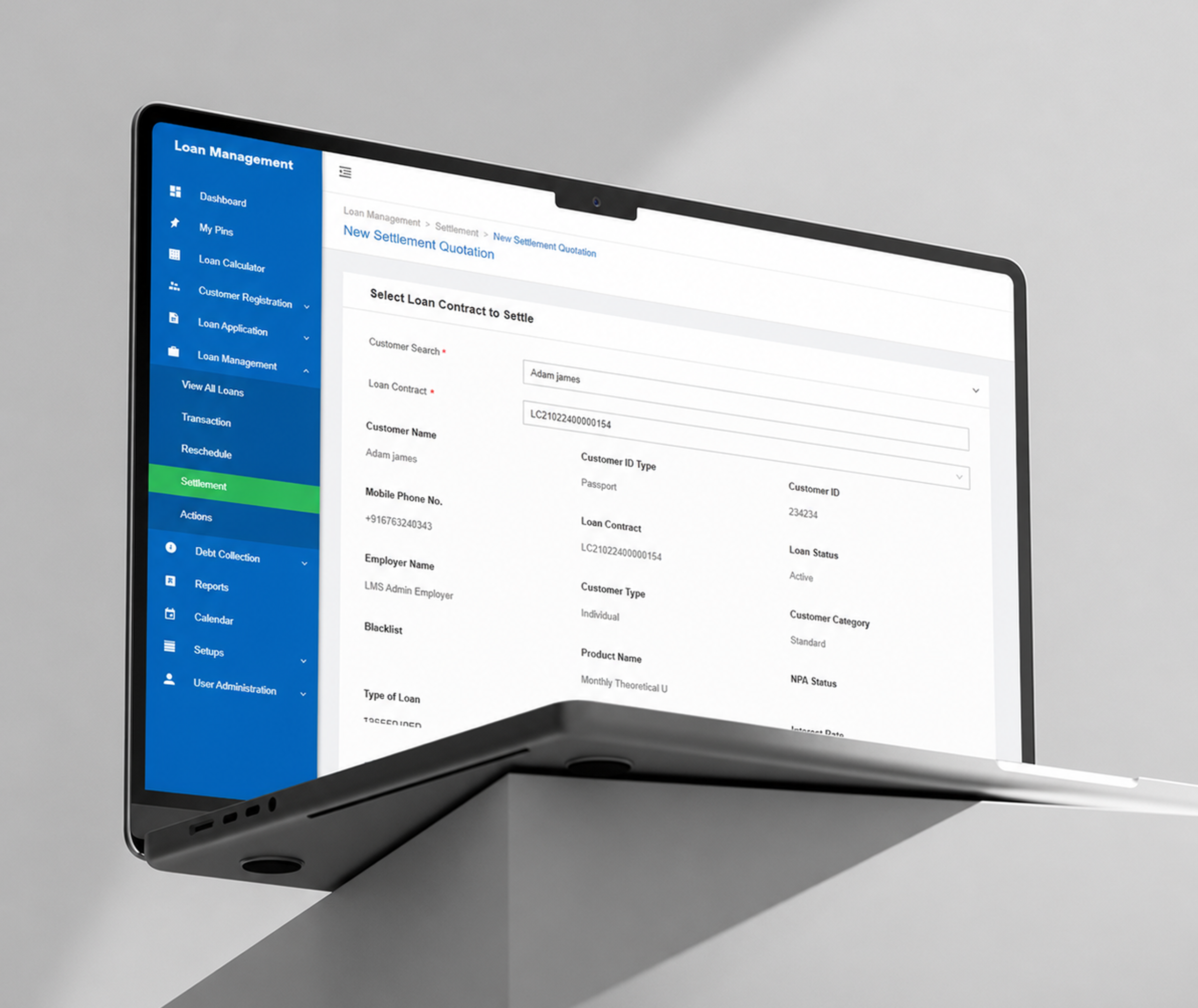
5. Settlement
The loan behaviour after disbursement is little unexpected and requires many different actions. When a customer affordability is high and they want to settle their loan then the system provides the ability to do so. Loan officers can send the quotations to the customers from the system and upon acceptance the loan will be settled after making the final transaction. The transaction can be reversed in the system if the customer does not wish to settle the loan.

6. Debt Collection
If any customer is not able to pay the loan as per the pay plan or misses the timeline the arrears are created in the loan and the customer's loan account is moved to the debt collection automatically. At this stage if the late fee is set in the system then as many times the loan goes into the arrears the late penalty fee is applicable. In Debt Collection, Agents are assigned for the particular customer which can be individual or an agency. The agents can update the status of the loan, capture the communication they have with customers, request different actions to loan officers like reschedule, settle, update details and many more. All the suggested actions are sent then to the users of the system and they can check all the communication and take actions in the system accordingly. Once the action is done it can be informed to the agents back and their commission is released as per setup in the system.

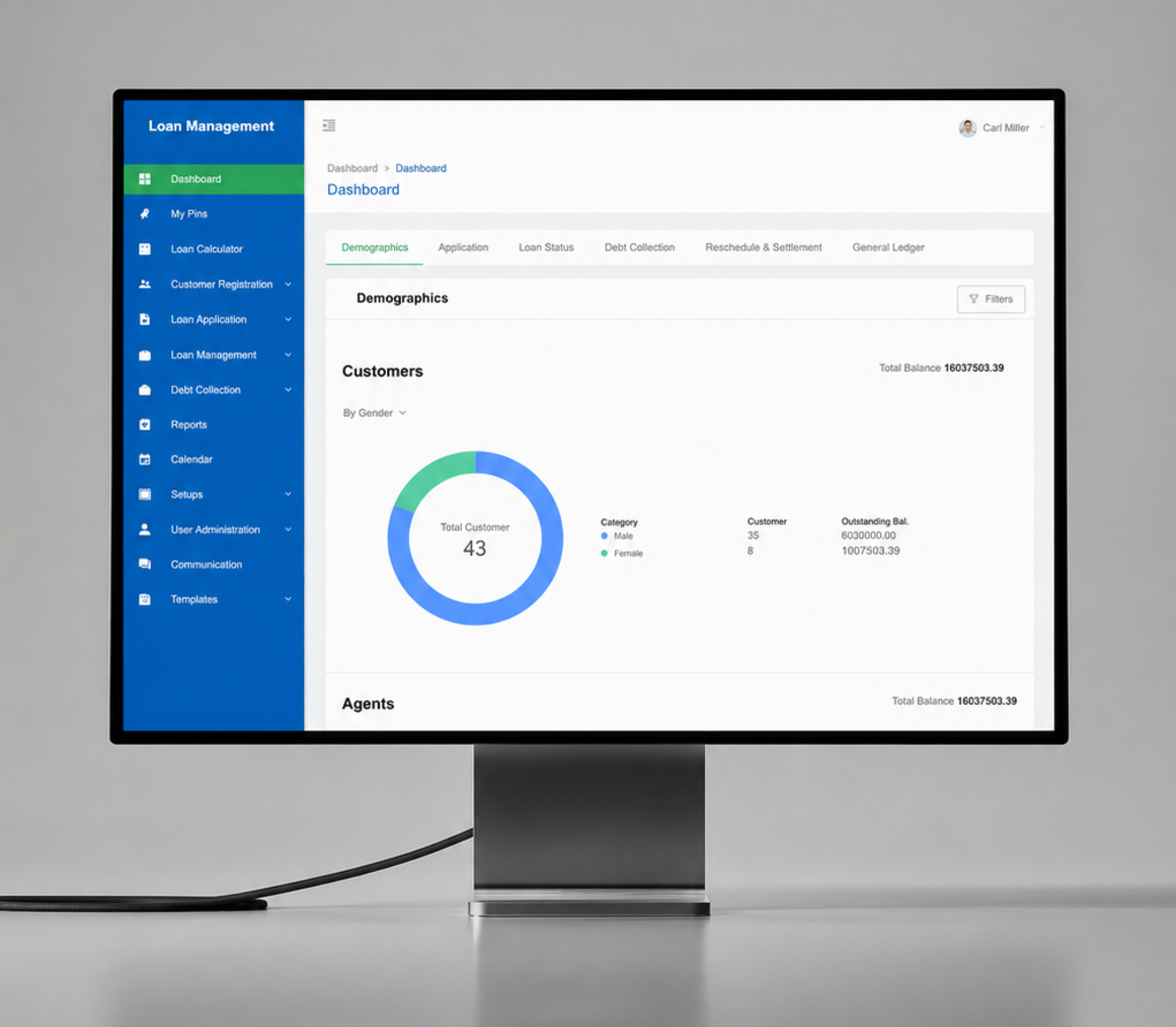
7. Dashboard
Dashboard is a section where all the statistics are to be seen by each user for multiple sections. It is a section where the user can see 50+ different statistics with the graph for better visuals to track the performance of multiple modules. There are multiple filter which can be applied and for the fine details in the dashboard.

8. Reports
As it is a NBFC company oriented solution the system provides 50+ predefined reports system users can download as per their need. Example: The users can download employee payroll deduction reports and send it to all the employers directly. There are many such reports that are developed in the system. Reports is an extended version of the dashboard where there is a lot of data in the tabular format and specific as per the system need. Filters are also there in order to get more specific data as per the user need. Users can download the reports in CSV and PDF format.

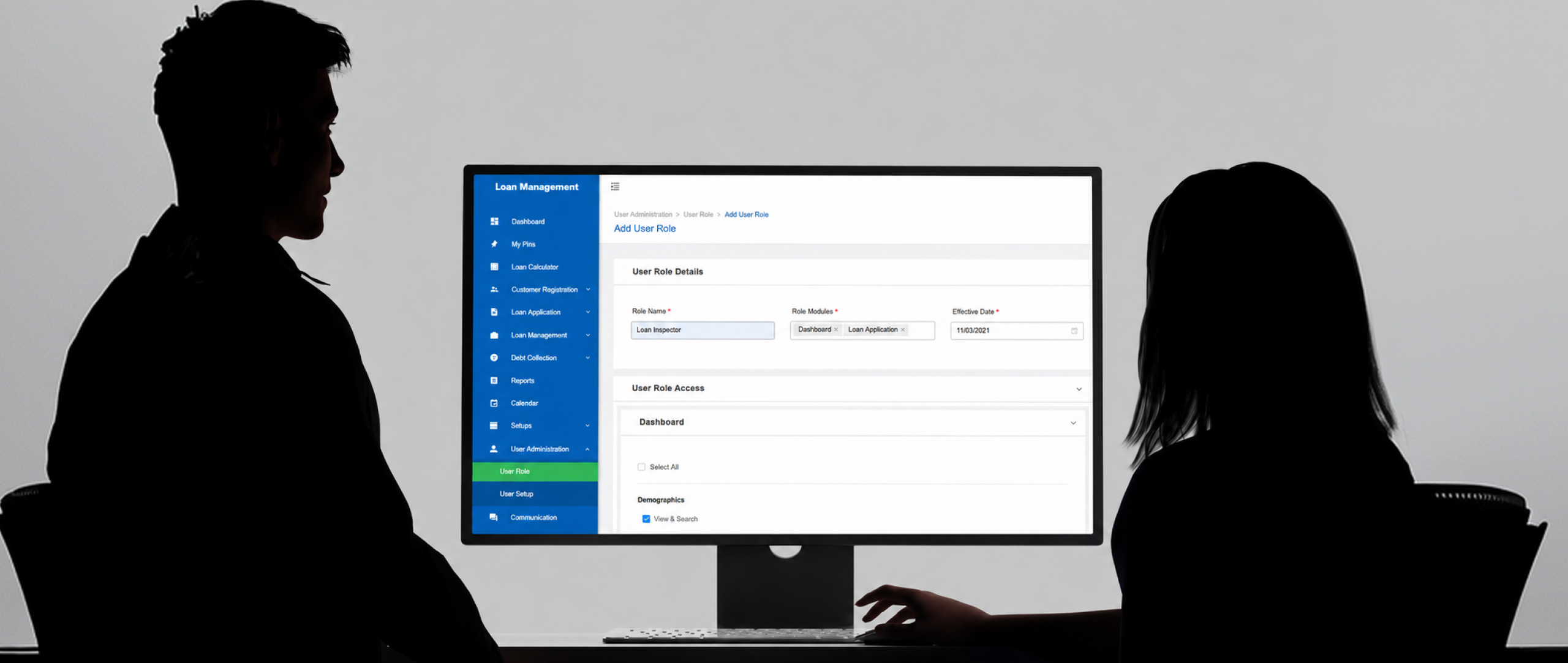
9. User Role and Access
Considering fintech solutions, there was a custom need for the admin to give the granular access to the system modules and functionalities. Each can have access to a specific functionality or a module. Based upon the rights in the system a user is given the ability to make changes in the same screen instead of following the different screens.

Backend and Web App Technology Stack
The system is built on a modern cloud-native stack with AWS infrastructure, Node.js backend, and React JS frontend.
Cloud & Infrastructure
AWS
Backend
Node.js, Docker, AWS ECS
Technologies
React JS, AdonisJs
Database
PostgreSQL (AWS RDS)
CICD
Gitlab, AWS Elastic Container Service, Gitlab Registry
Load Balancer
AWS Application Load Balancer, Nginx
Conclusion
The NBFC Loan Management System automates the complete loan lifecycle from origination to debt collection for a lending company in Botswana. With 450+ page designs, 50+ reports, offline capability via PWA, and granular user access control, the platform handles secured and unsecured loan products across multiple institutions and branches.
NEED A CUSTOM FINTECH SOLUTION?
Let us help you build a loan management platform tailored to your lending operations.
More Projects