Navium OS

Available on:

Transaction Management Platform for Real Estate Brokerages

Talk to the Team
Deliverables
Custom Web App Development
Industry
Real Estate
Duration
Working since Feb 2026
Country
USA
Navium OS
Overview

Business Goals & Project Overview

Business Goals

Marcus & Company Realty needed a transaction management platform that matched how their brokerage actually operates, not a generic tool they had to work around. The goal was to replace their existing system with something built around their own commission structures, deal types, and day-to-day reporting needs.

Project Overview

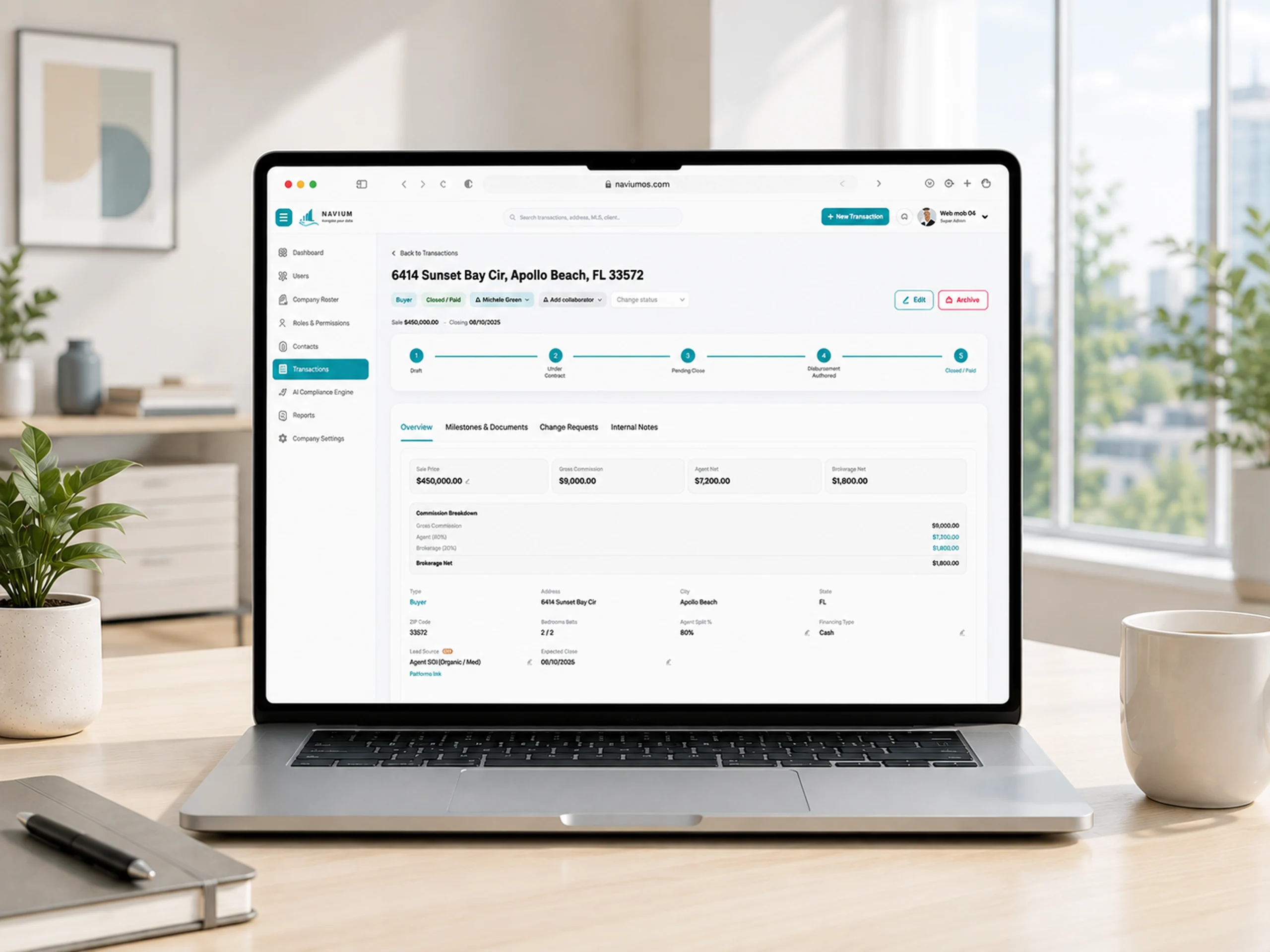
NaviumOS is a transaction management platform built for Marcus & Company Realty, a real estate brokerage in Sarasota and Manatee County, Florida. It replaces a legacy system that no longer matched how the brokerage operated as its transaction volume and complexity grew. The platform is structured around the brokerage's own commission rules, fee structures, and reporting needs, managing all four ways a deal can be structured: Buyer, Seller, Dual, and Referral, each with its own commission logic, status flow, and path to disbursement. Beyond core transaction handling, NaviumOS supports accurate financial reporting, document and compliance checks that flag issues without removing human judgment, and task automation built around the brokerage's existing workflows.

Proven Results

Measurable Outcomes That Made a Difference

Replacing a legacy system meant more than moving data. NaviumOS was built around how this brokerage actually calculates commissions, assigns tasks, and manages transactions.

60%Fewer Manual Cross-Checks
70%Fewer Manually Rebuilt Checklists
5 hrs Saved Per Reporting Cycle
3xMore Visibility Into Where Every Transaction Stands
Challenges & Solutions

Challenges Faced and Conquered

The brokerage needed more than a standard transaction management tool. It needed a platform designed around its real deal structures, automated workflows, accurate commission calculations, and reporting it could trust.

The Challenge

An Outside System They Couldn't Shape

The brokerage ran on a third-party tool that treated every deal type almost identically, despite Buyer, Seller, Dual, and Referral deals following different rules. Ongoing licensing costs bought no real ability to shape the product or fix mismatched fee logic.

Our Solution

We built NaviumOS as the brokerage's own proprietary platform, structured around their four real deal types, so there's no vendor licensing cost and every feature and fee rule can be shaped directly around what the brokerage needs.

The Challenge

Manual Work, Limited Oversight

Staff manually recreated the same multi-step checklist for every new deal, checked documents for missing data by hand, and had no reliable way to see who owned which task or what was falling behind.

Our Solution

Automated task generation recreates the brokerage's checklists the moment a transaction reaches the right stage, while an AI-assisted compliance layer flags document issues early with a person always making the final call.

The Challenge

Commission Numbers Didn't Add Up

Dual transactions, where each side of a deal can carry a different rate and split, had no dependable way to calculate correctly, and small rounding differences across hundreds of transactions eroded trust in the totals.

Our Solution

A calculation engine built around the brokerage's real deal types now computes each side of a Dual transaction independently before combining them into one accurate figure, verified against real historical transactions before launch.

The Challenge

Reports Didn't Reflect the Real Business

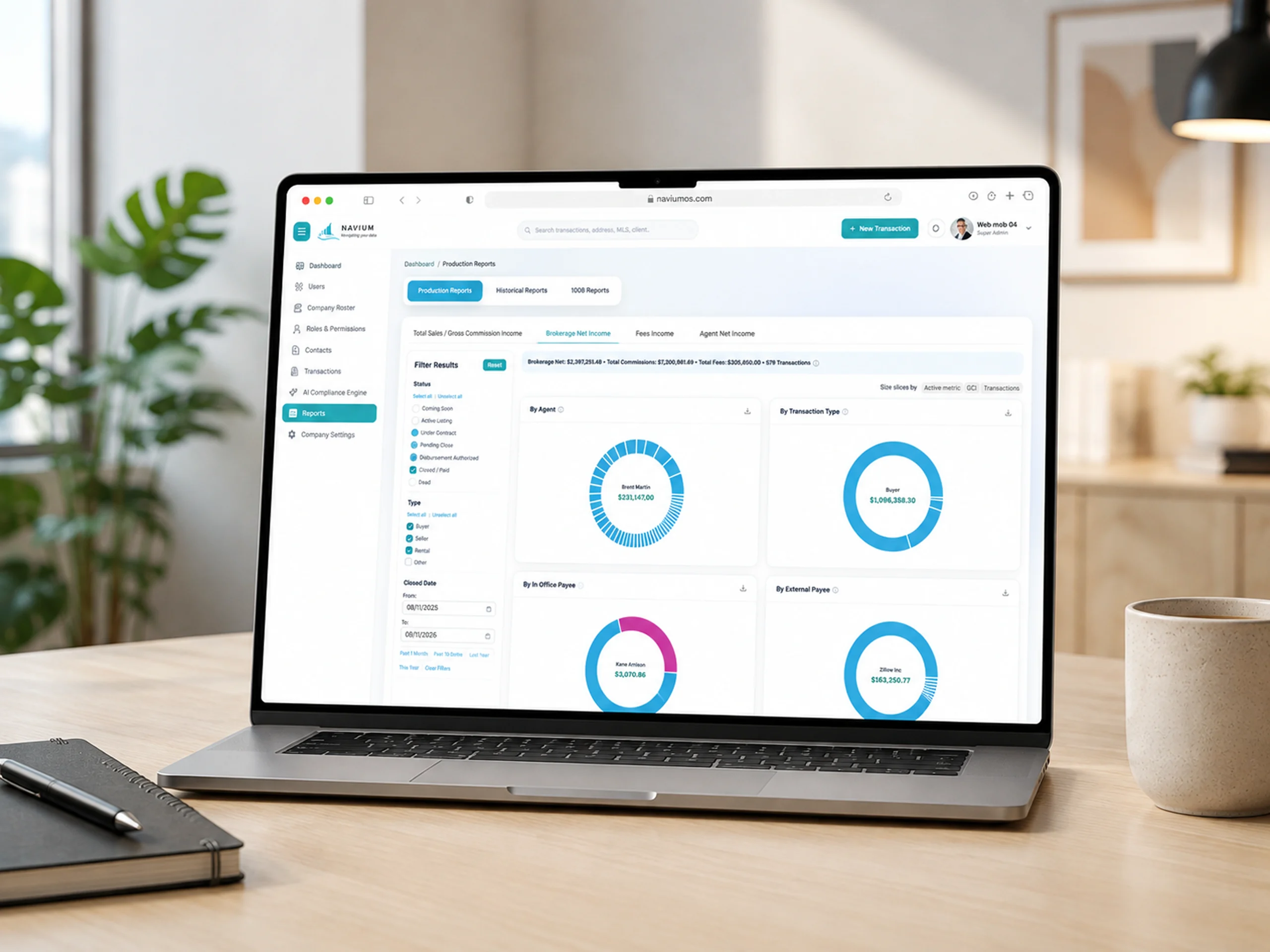
Reports blended different deal types into one view, Referral transactions (which don't generate a normal commission) were pulling down average-commission figures, and past reports could shift if an older transaction was edited.

Our Solution

Reports now separate each deal type clearly, keep Referral transactions on their own track, and lock report figures permanently once generated, so a number pulled today still matches the same report months later.

Features Implemented

Key Features & Functionality

  • Key Features & Functionality
  • Key Features & Functionality
  • Key Features & Functionality
  1. Commission Calculation Engine

    Calculates each side of a Dual transaction independently, applying its own rate, split, and fee logic, then combines both into one accurate final figure.

  2. Disbursement Authorization

    Generates a complete payout summary the moment a deal is ready to close, laying out agent, brokerage, and payee amounts in one place.

  3. AI Compliance Engine

    Reviews documents before they move forward and flags anything missing or inconsistent, with a person always making the final approval decision.

  4. Configurable Task Templates

    Lets admins build checklists once, define what triggers them, and adjust tasks and assignees as the brokerage's process changes, without needing new development.

  5. Automated Tasks

    Turns existing checklists into self-generating task lists that appear automatically, already assigned and due-dated, the moment a transaction reaches a meaningful stage.

  6. Transaction Status Tracking

    Tracks status separately for each deal type, since Buyer and Seller deals move through different stages; status reversal is restricted to specific roles only.

  7. Role-Based Access

    Gives every user exactly the access they need agents see their own deals, admins see the whole brokerage, and sensitive actions stay locked to specific roles.

  8. Reporting Dashboard

    Shows sales volume, gross commission, and net income office-wide or agent by agent, keeping Referral deals separate and locking figures once a report is generated.

  9. Contacts Management & Follow Up Boss Integration

    Syncs client and lead data directly from Follow Up Boss CRM, tagging CRM-sourced contacts clearly so agents know where information came from.

  10. User Management & Company Roster

    Shows agents the full brokerage team and lets admins control exactly what each person can see and do as the organization grows

  11. Notification Alerts

    Surfaces new tasks, overdue items, and AI compliance flags in one place, so agents and admins always know when something in their world has changed.

  12. Collaborator Management

    Adds other agents, coordinators, or team members to a specific deal without changing who owns it, keeping accountability clear as a transaction's team shifts.

Our Tech Stack

The Right Tools for Every Challenge

Navium OS is built on a scalable digital architecture using React, Node.js, TypeScript, and PostgreSQL to deliver secure and connected business operations across the USA.

React 19
Google SSO
Microsoft Azure
Ant Design
Tailwind CSS
The Result

From Manual Processes to Connected Operations

NaviumOS turned a generic, licensed transaction management tool into a system Marcus & Company Realty fully owns, built around their own commission rules, deal types, and reporting needs. Automated commission calculation, AI-assisted compliance checks, and self-generating task lists give agents and staff accurate numbers and clear visibility from the first day of a deal through to disbursement.

  • Commission Calculation

    Before
    Manual re-checking, error-prone Dual-side math
    After
    Automated engine, independent per-side calculation
  • Task Checklists

    Before
    Recreated by hand for every deal
    After
    Auto-generated the moment a transaction hits the right stage
  • Document Review

    Before
    Fully manual, no early flagging
    After
    AI-assisted compliance checks with human sign-off
  • Reporting

    Before
    Deal types blended, figures could shift later
    After
    Separated by deal type, locked once generated
From Discovery to Production

A Structured Path From Idea to Launch

  1. Discovery & Strategy

    Understood the business goals, user needs, existing workflows, and technical requirements.

    Discovery & Strategy
  2. Solution Architecture

    Defined the system architecture, technology stack, integrations, and data flow required for the solution.

    Solution Architecture
  3. Development & Integration

    Built the core platform in agile sprints, integrating APIs, backend services, frontend experiences.

    Development & Integration
  4. Deployment & Rollout

    Launched the solution, monitored performance, resolved initial issues, and ensured a smooth transition to production.

    Deployment & Rollout
  5. Testing & Optimization

    Validated functionality, performance, security, and usability before preparing the solution for production.

    Testing & Optimization
Use Cases

Built to Improve the Business Behind Every Deal

NaviumOS transforms the brokerage's daily operations through greater ownership, automated workflows, accurate commission calculations, and reliable reporting, helping teams work more efficiently and make decisions with confidence.

  • Full Ownership, No Vendor Lock-In

    The brokerage owns its platform outright, with every fee rule and workflow shaped around its own operations instead of a vendor's roadmap.

  • Accurate Commission on Every Deal

    Independent per-side calculation on Dual transactions means the final payout figure is correct to the cent, every time.

  • Less Manual Checklist Work

    Task lists generate themselves the moment a deal reaches the right stage, so nothing depends on someone remembering to start the process.

  • Compliance Issues Caught Early

    AI-assisted document review flags problems while they're still easy to fix, with a person always making the final call.

Conclusion

NaviumOS was built for one real brokerage to solve real problems around commission accuracy, reporting integrity, and the everyday work of running a busy real estate office, replacing an outside system Marcus & Company Realty had no ability to shape on their own terms. From independent Dual-side commission calculations to self-generating task lists, every part of the platform reflects how the brokerage actually works, built to keep adapting as their business grows.

We've a lot more to showcase here, around 700+ projects.

FAQ

Frequently Asked Questions

Questions About Building Custom Real Estate Software

Your Success, Our Commitment

Empowering businesses with innovative technology, uncompromising quality, and customer-first solutions.

Pramesh Jain

Founder & CEO

For NaviumOS, we built a commission engine that calculates each side of a Dual transaction completely independently, using that side's own rate and agent split, since the two sides don't always match. Only after both sides are calculated separately does the system combine them into one accurate final number.

Yes. For NaviumOS's AI Compliance Engine, we built it to flag missing or inconsistent information in documents, but it never approves or blocks anything on its own. A person always makes the final call, which was a deliberate design decision for a business that can't afford automated errors.

With NaviumOS, we modeled the platform's fee structures, commission logic, and task checklists directly on how the brokerage already ran their business, rather than adapting a generic template. The goal was removing manual work without asking staff to learn a new process.

In NaviumOS, tasks generate automatically the moment a transaction reaches a meaningful point, like a status change or a price update, with the correct due date and the right person assigned automatically. This replaced a manual checklist process the brokerage was previously repeating by hand for every deal.

In a typical deal, figuring out who gets paid what usually means piecing together separate notes, fee breakdowns, and payee lists by hand. For NaviumOS, we built the Disbursement Authorization to generate automatically the moment a deal is ready to close, combining the agent's payout, the brokerage's share, and any third-party payee into one document. Even for a Dual transaction, where two sides of a deal are involved, it produces a single combined summary instead of two separate ones someone would otherwise have to reconcile manually.

Building NaviumOS meant going deep on the specific rules of one business, Florida real estate commission structures, disclosure requirements, and brokerage-specific fee logic, rather than building something generic and hoping it fit. That level of specificity is usually what separates software a business actually adopts from something they end up working around.